Bob

Void and the Unit

Introduction

In our last on-line class we continued to practice with the energies of the unit:  idea; structure; intuitive principle and unifying energy.  Our practice expanded to experience the unit in manifest, hidden and divine dimensions of consciousness.  Our Aikido technique was katate-dori kokyu nage.  We practiced to experience the technique in manifest, hidden and divine both as uke and nage.

Our continuing goal was to experience the difference in the unit in each realm and see how they could benefit and complement each other.   

The unit is the part of ourselves that contains the skills and abilities necessary to accomplish the tasks for which that unit is created.  The energetic content of the unit is decided by the skills necessary to perform that particular function and therefore will vary from unit to unit.  Performing brain surgery is a very different unit than running a marathon.  Being a parent is very different than being the CEO of a company.  One of the most commonly asked questions in Aikido is, why is it so difficult to transfer the good feeling I get in class to other activities?  One response is the energies of Aikido are unique to Aikido.  The chemistry is the same but the chemicals (energies of the unit) are different in each situation.

The unit is the clothing we wear to accomplish particular tasks or assume particular roles.  O Sensei called the unit haku-Essence of Aikido (pg.27). 

This process as I of “inhabiting” particular units is often unconscious.  When we walk to our car to drive home, that is a unit, one to which we don’t generally give much attention.  Some basic units are much more a part of our identity than others.  Examples include your choice of work; your place in a family or other important social groups. 

The overall goal of this series of classes is to help create a more balanced and integrated unit that functions better and  allows a better forging to occur between the I and the unit resulting in better performance and more personal satisfaction. 

Our goal initially, has been to experience the basic parts of the unit and their interaction with each other.  It is in this conscious interaction that a real opportunity for a balanced and integrated unit exists.  If the basic parts of the unit are not consciously experienced we may miss important elements of the unit and therefore start from a place of fragmentation rather than wholeness.  Our best experience is not available for the task at hand.  If that is not addressed we will experience the downstream negative effects of that fragmentation, in reduced performance and satisfaction. 

One way fragmentation occurs is when action is taken from only some of the energies of the unit that are the most readily available to our experience.  An example is, we get a good idea of taking action and don’t allow an experience of the other energies that make up the unit of that idea.  We may then run out of energy and can’t complete the task well or at all.  This can happen when the idea or one of the other energies of the unit is put in a position of carrying the whole task of performance.  A fully formed unit is much more likely to produce the outcome we envision. 

O Sensei laid out the parts of a fully integrated unit-Essence of Aikido (pgs. 32-33).  He called them the four souls and the eight powers. 

The four souls are:  the intelligent soul; the rough soul; the gentle soul and the optimistic soul. 

The eight powers are:  movement and calm; release and solidification; retraction and extension and unification and division.

These are high level examples of what makes up a fully functioning unit.  We are going to work with this four count model and apply it specifically to the units we experience.    

As stated earlier, the version of the four counts of the unit with which we will work in this series of classes is:  the idea; the structure; the intuitive element and the unifying principle.  The first two energies we refer to as the obvious ones.  They come up easily and often.  What is my goal and how will I achieve it?  The second two we call the not so obvious because they often need specific focus in order to be consciously experienced. 

One example of the four counts is the task of building a house.  Energy 1-the idea-is like the architect who does the design and provides the blueprint.  Energy 2-is the contractor who actually builds the house using the blueprint from the architect as a guide and a starting point.  Energy 3-is the interior designer who crafts the living space so the house is not only livable but a pleasure to live in.  Energy 4-is the overall manager who brings the other three together into a fully working unit. 

One very important principle throughout this series is that every unit has value!

We will use a kata like version of a basic Aikido technique as our physical reference. 

We have focused on laying out a map of consciousness and practicing how to navigate on that map.  We all know that the map is not the territory.  Keeping that in mind, we have shifted to a more experiential practice utilizing what we have gained from the previous classes.  We will still refer to the map but in a less reflective way and put more focus on the experiential, relying on our previous practice with the map to help us to navigate it.

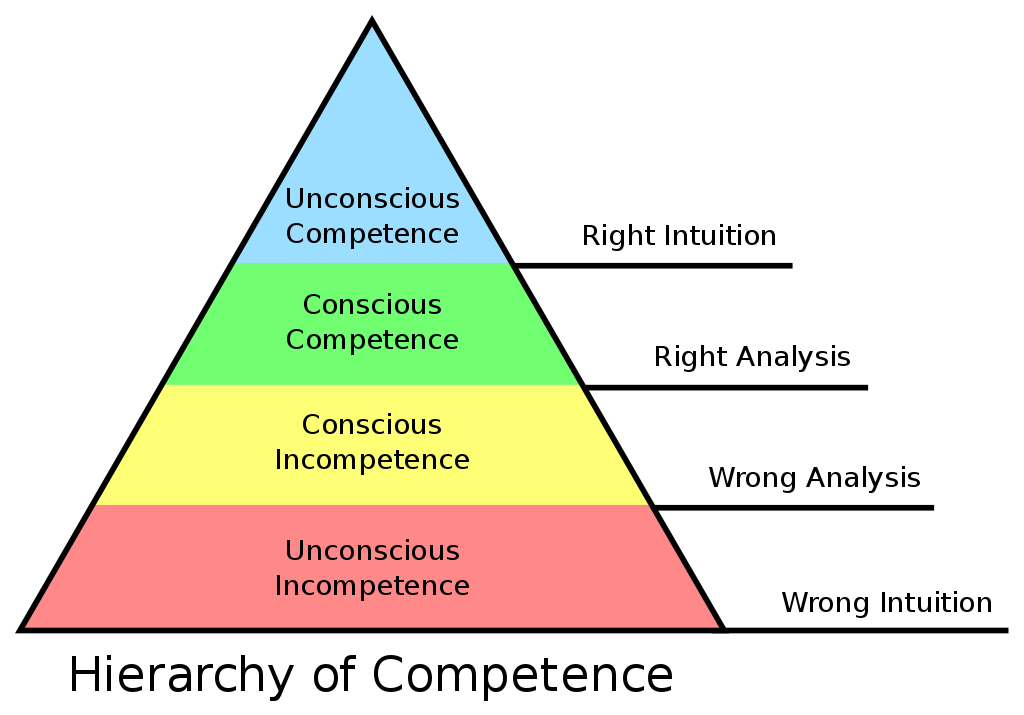
Noel Burch, educational trainer, developed a model of mastering a skill called the Four Stages of Competence.  The four stages are:  unconsciousness incompetence-I don’t know what I don’t know; conscious incompetence-I know what I don’t know; conscious competence-I know what I know and unconscious competence-I can manifest what I know without having to think about it.  In this class and the previous classes we are moving through this process to conscious competence and the early stages of unconscious competence.  At this final stage our ability to function as a balanced and integrated unit can happen without reflection on the four counts.  When we then move to the next level of that unit the process is repeated perhaps skipping the first stage of unconscious incompetence.  When changing from one unit to another we may go back to the first stage of unconscious incompetence.

Aikido is an art that teaches us to productively deal with feedback, both positive and negative in a healthy way.  The feedback helps to emphasize the positive part of our experience and work to improve negative experience.

We will add to the practice we started in our last class to work with a multi-dimensional experience of the unit including manifest, hidden and divine, but add the integrating experience of the void. 

The void is that aspect of existence which is most basic.  It is most basic in that it is the source of all aspects of the creation but is not “created” itself.  It is ever present and unchanging.  One way to approach understanding the void is a principle called the two truths doctrine The Religion of Tomorrow Ken Wilbur (pgs. 23 and 164). 

As we move into an experience of the void at first it is an experience of the absolute unchanging state.  As our experience of the void gets more and more full it reaches a state of non-duality where even the distinction between the relative and absolute realms is transcended.

Let’s bow in and start with misogi breathing and a good full warm-up.

Our tip today on the misogi breathing is to continue to work on the the five principles of misogi breathing from Koichi Tohei Sensei:  let’s focus on the third of the five principles- breathe out the Ki of your head to the Ki of your toes.  By combining this principle with the first two we get both a more complete whole body experience. 

Five Principles for Ki Breathing
1. Breathe out with the sound of HA, don’t let your breath just leak out
2. Breathe out as calmly and quietly as possible
3. Breathe out the Ki of your head to the Ki of your toes
4. Breathe in from the tip of your nose until your body is full of air
5. Calm your mind infinitely smaller at the one point after inhaling 

Multi-Dimensional Experience of the Unit

Today we will continue to use the basic Aikido technique katate-dori kokyu nage as our practice technique.  Please refer to the video of the technique on our Facebook Group for a clear visual of the movement.  Our goal today is to expand the practice with the unit in all three basic dimensions of consciousness:  manifest; hidden and divine and add the void.  Details about these dimensions are available in class notes and videos on our dojo web site.  We will move through the first three-the manifest, hidden and divine-a little more quickly than last time so we can spend some time on the void.

  1. Let’s begin with a round of katate-dori kokyu nage in the manifest. Start just focusing on the experience of your body.  What aspect of your body attracts your attention?  Then shifting the focus from the body to your current physical environment, what attracts your attention there? 

This provides an initial experience of you as a physical being in a physical world.  Then let’s focus on the physical experience of you both as the uke and nage stepping in with a grab for the hand and then turning and throwing.  What is your experience?  Feel the depth of contact with your partner’s entire body.  What energies are called up in your system as you step in and throw? Now let’s shift to the hidden dimension of subtle energies.  We can make the shift from manifest/physical to hidden/energetic through our basic practice of feeling energy flow between our hands and then using the universal post practice by opening the hands and arms in a circle to feel a fuller sense of the energy body.  Then to complete the transition let’s go to our circle/center practice to experience ourselves as an energy being in an energy world.  What energies in your system does this practice bring up?  Then let’s go back to the technique both as uke and nage to see how your experience of this unit changes in the hidden dimension.

    • Get feedback-your experience of the technique in the manifest and hidden dimensions? How are they different from each other? 
  1. Now let’s shift to the divine dimension of creative emptiness. We can use the circle/center practice to enter a state of deep quiet.  This quiet is a doorway to the divine dimension of creative emptiness.  The divine body in the divine world is like an outline of a potential body, but a real body with experience.  What divine energies in your system does the practice bring up?  Then let’s go back to the technique and see how your experience of this unit changes in the divine dimension.
    • Get feedback-your experience of the technique in the divine dimension? How is it different from the manifest and hidden? 

 Experiencing the Void

  1. Now we will move to the experience of the void. To begin let’s go back to the circle/center practice and to that place of great quiet.  Within that space of great quiet allow the void to fill that space.  This is a doorway to the direct experience of the void.  It is most important to maintain your center as there are no external reference points in the void.  One approach to maintaining an experience of center is that center in an infinite unchanging space is everywhere. Each point is equidistant from all other points.  Therefore every place in the void is center.  To translate this principle into experience let’s use a practice of mirroring.  All parts of the void mirror each other equally.  This allows a fullness of experience and having a center as a reference point.  To move from this experience to a practice of functionality in the void, let’s refer back to O Sensei’s description with which we began-The Secret Teachings of Aikido (pg. 53).  This is the foundation for experiencing the seeming paradox of functionality in the void.  Let’s now go back to the technique of katate-dori kokyu nage from the void.
    • What is your experience? How is it unique when compared with the previous experiences of the technique?

Conclusion

In this class we continued to extend our practice of the unit to include the void.  Our goal was to experience the unit in each of these three basic dimensions and in the void.  We also wanted to focus on how they can be of benefit to each other and to you as a whole person.   

Feedback on practice.

Practice before next class

Use the practice of katate-dori kokyu nage as a physical metaphor for a unit and extend the practice to the void.  See how the void can add its own benefit to your practice. 

A Light on Transmission (pg. 1).

Finish with misogi breathing and bowing out.

Multi-Dimensional Experience of the Unit

Introduction

In our last on-line class we continued to practice with the four basic energies of the unit:  idea; structure; intuitive principle and unifying energy.  We practiced with these four energies of the unit as they are manifested in the Aikido technique mune-tsuki irimi nage but in a less structured and more experiential way.  Our shift in our last class was to expand the focus from the manifest/physical and include the hidden/energetic and the divine/causal realm of primal emptiness as we went through the movements both as uke and nage.

We then worked on going through rounds of practice on each realm of consciousness.  Our goal was twofold:  experience the difference in the unit in each realm and see how they could benefit and complement each other.   

The unit is the part of ourselves that contains the skills and abilities necessary to accomplish the tasks for which that unit is created.  The energetic content of the unit is decided by the skills necessary to perform that particular function and therefore will vary from unit to unit.  Performing brain surgery is a very different unit than running a marathon.  Being a parent is very different than being the CEO of a company.  One of the most commonly asked questions in Aikido is, why is it so difficult to transfer the good feeling I get in class to other activities?  One response is the energies of Aikido are unique to Aikido.  The chemistry is the same but the chemicals (energies of the unit) are different in each situation.

The unit is the clothing we wear to accomplish particular tasks or assume particular roles.  O Sensei called the unit haku-Essence of Aikido (pg.27). 

This process as I of “inhabiting” particular units is often unconscious.  When we walk to our car to drive home, that is a unit, one to which we don’t generally give much attention.  Some basic units are much more a part of our identity than others.  Examples include your choice of work; your place in a family or other important social groups. 

The overall goal of this series of classes is to help create a more balanced and integrated unit that functions better and  allows a better forging to occur between the I and the unit resulting in better performance and more personal satisfaction. 

Our goal initially, has been to experience the basic parts of the unit and their interaction with each other.  It is in this conscious interaction that a real opportunity for a balanced and integrated unit exists.  If the basic parts of the unit are not consciously experienced we may miss important elements of the unit and therefore start from a place of fragmentation rather than wholeness.  Our best experience is not available for the task at hand.  If that is not addressed we will experience the downstream negative effects of that fragmentation, in reduced performance and satisfaction. 

One way fragmentation occurs is when action is taken from only some of the energies of the unit that are the most readily available to our experience.  An example is, we get a good idea of taking action and don’t allow an experience of the other energies that make up the unit of that idea.  We may then run out of energy and can’t complete the task well or at all.  This can happen when the idea or one of the other energies of the unit is put in a position of carrying the whole task of performance.  A fully formed unit is much more likely to produce the outcome we envision. 

O Sensei laid out the parts of a fully integrated unit-Essence of Aikido (pgs. 32-33).  He called them the four souls and the eight powers. 

The four souls are:  the intelligent soul; the rough soul; the gentle soul and the optimistic soul. 

The eight powers are:  movement and calm; release and solidification; retraction and extension and unification and division.

These are high level examples of what makes up a fully functioning unit.  We are going to work with this four count model and apply it specifically to the units we experience.    

As stated earlier, the version of the four counts of the unit with which we will work in this series of classes is:  the idea; the structure; the intuitive element and the unifying principle.  The first two energies we refer to as the obvious ones.  They come up easily and often.  What is my goal and how will I achieve it?  The second two we call the not so obvious because they often need specific focus in order to be consciously experienced. 

One example of the four counts is the task of building a house.  Energy 1-the idea-is like the architect who does the design and provides the blueprint.  Energy 2-is the contractor who actually builds the house using the blueprint from the architect as a guide and a starting point.  Energy 3-is the interior designer who crafts the living space so the house is not only livable but a pleasure to live in.  Energy 4-is the overall manager who brings the other three together into a fully working unit. 

One very important principle throughout this series is that every unit has value!

We will use a kata like version of a basic Aikido technique as our physical reference. 

We have focused on laying out a map of consciousness and practicing how to navigate on that map.  We all know that the map is not the territory.  Keeping that in mind, we have shifted to a more experiential practice utilizing what we have gained from the previous classes.  We will still refer to the map but in a less reflective way and put more focus on the experiential, relying on our previous practice with the map to help us to navigate it.

Noel Burch, educational trainer, developed a model of mastering a skill called the Four Stages of Competence.  The four stages are:  unconsciousness incompetence-I don’t know what I don’t know; conscious incompetence-I know what I don’t know; conscious competence-I know what I know and unconscious competence-I can manifest what I know without having to think about it.  In this class and the previous classes we are moving through this process to conscious competence and the early stages of unconscious competence.  At this final stage our ability to function as a balanced and integrated unit can happen without reflection on the four counts.  When we then move to the next level of that unit the process is repeated perhaps skipping the first stage of unconscious incompetence.  When changing from one unit to another we may go back to the first stage of unconscious incompetence.

Aikido is an art that teaches us to productively deal with feedback, both positive and negative in a healthy way.  The feedback helps to emphasize the positive part of our experience and work to improve negative experience.

We will continue the practice we started in our last class to work with a multi-dimensional experience of the unit including manifest, hidden and divine, let’s bow in and start with misogi breathing and a good full warm-up.

Our tip today on the misogi breathing is to continue to work on the the five principles of misogi breathing from Koichi Tohei Sensei:  let’s focus on the second of the five principles-breathing out as calmly and quietly as possible.  By combining this principle with the first one we get both an expansive experience and one that is relaxing. 

Five Principles for Ki Breathing
1. Breathe out with the sound of HA, don’t let your breath just leak out
2. Breathe out as calmly and quietly as possible
3. Breathe out the Ki of your head to the Ki of your toes
4. Breathe in from the tip of your nose until your body is full of air
5. Calm your mind infinitely smaller at the one point after inhaling 

Multi-Dimensional Experience of the Unit

Today we will use the basic Aikido technique katate-dori kokyu nage as our practice technique.  Please refer to the video of the technique on our Facebook Group for a clear visual of the movement.  Our goal today is to continue the practice with the unit in all three basic dimensions of consciousness:  manifest; hidden and divine.  Details about these dimensions are available in class notes and videos on our dojo web site.  We will move through the first two-the manifest and hidden-a little more quickly than last time so we can spend more time on the divine than we were able to in our last class.

  1. Let’s begin with a round of katate-dori kokyu nage in the manifest. Start just focusing on the experience of your body.  What aspect of your body attracts your attention?  Then shifting the focus from the body to your current physical environment, what attracts your attention there? 

This provides an initial experience of you as a physical being in a physical world.  Then let’s focus on the physical experience of you as the uke stepping in with a grab for the hand.  What is your experience?  The uke is a unit equal in every way in importance as the nage.  The role of the uke is to assist in the balanced development of the nage.  Now let’s shift to the nage side of katate-dori kokyu nage.  You have practiced as uke, now receive your own attack.  You start by turning your entire body to blend with the attack.  Then step forward with your front foot and throw the uke into a forward roll.  Feel the depth of contact with your partner’s entire body.  What energies are called up in your system as you step in and throw?    

    • Get feedback-what was your experience the manifest level of this technique?  
  1. Now let’s shift to the hidden dimension of subtle energies. We can make the shift from manifest/physical to hidden/energetic through our basic practice of feeling energy flow between our hands and then using the universal post practice by opening the hands and arms in a circle to feel a fuller sense of the energy body.  Then to complete the transition let’s go to our circle/center practice to experience ourselves as an energy being in an energy world.  What energies in your system does this practice bring up?  Then let’s go back to the technique both as uke and nage to see how your experience of this unit changes in the hidden dimension.
    • Get feedback-your experience of the technique in the hidden dimension?
  1. Now let’s shift to the divine dimension of creative emptiness. We can use the circle/center practice to enter a state of deep quiet.  This quiet is a doorway to the divine dimension of creative emptiness.  The divine body in the divine world is like an outline of a potential body, but a real body with experience.  What divine energies in your system does the practice bring up?  Then let’s go back to the technique and see how your experience of this unit changes in the divine dimension.
    • Get feedback-your experience of the technique in the divine dimension?

Conclusion

In this class we continued to extend our practice of the unit to the hidden and divine dimensions.  Our goal was to experience the unit in each of these three basic dimensions.  We also wanted to focus on how they can be of benefit to each other and to you as a whole person.   

Feedback on practice.

Practice for next class

Use the practice of katate-dori kokyu nage as a physical metaphor for a unit and work with it in the manifest, hidden and divine dimensions.  See how they can benefit each other and you as a whole person. 

The Secret Teachings of Aikido (pg. 52).

Finish with misogi breathing and bowing out.

Multi-Dimensional Experience of the Unit

Introduction

In our last on-line class we continued to practice with the four basic energies of the unit:  idea; structure; intuitive principle and unifying energy.  We practiced with these four energies of the unit as they are manifested in the Aikido technique mune-tsuki irimi nage but in a less structured and more experiential way.  Our shift in this class was to focus less on reflecting on the counts of the unit as a map of consciousness and more on direct experience as we went through the movements both as uke and nage.

We continued to work with the four levels of competence-from unconscious incompetence to unconscious competence.  We then worked on going through two rounds of practice.  The first one focused on the mune-tsuki irimi nage as an Aikido technique and then went more deeply into the unit to see which count or counts needed more time and attention in order to integrate more fully with the other counts.  The goal was to work with that count directly and give it the attention it needed and then re-integrate the unit.  We then went back to the technique to see if the more fully integrated unit actually performed better. 

The unit is the part of ourselves that contains the skills and abilities necessary to accomplish the tasks for which that unit is created.  The energetic content of the unit is decided by the skills necessary to perform that particular function and therefore will vary from unit to unit.  Performing brain surgery is a very different unit than running a marathon.  Being a parent is very different than being the CEO of a company.  One of the most commonly asked questions in Aikido is, why is it so difficult to transfer the good feeling I get in class to other activities?  One response is the energies of Aikido are unique to Aikido.  The chemistry is the same but the chemicals (energies of the unit) are different in each situation.

The unit is the clothing we wear to accomplish particular tasks or assume particular roles.  O Sensei called the unit haku-Essence of Aikido (pg.27). 

This process as I of “inhabiting” particular units is often unconscious.  When we walk to our car to drive home, that is a unit, one to which we don’t generally give much attention.  Some basic units are much more a part of our identity than others.  Examples include your choice of work; your place in a family or other important social groups. 

The overall goal of this series of classes is to help create a more balanced and integrated unit that functions better and  allows a better forging to occur between the I and the unit resulting in better performance and more personal satisfaction. 

Our goal initially, has been to experience the basic parts of the unit and their interaction with each other.  It is in this conscious interaction that a real opportunity for a balanced and integrated unit exists.  If the basic parts of the unit are not consciously experienced we may miss important elements of the unit and therefore start from a place of fragmentation rather than wholeness.  Our best experience is not available for the task at hand.  If that is not addressed we will experience the downstream negative effects of that fragmentation, in reduced performance and satisfaction. 

One way fragmentation occurs is when action is taken from only some of the energies of the unit that are the most readily available to our experience.  An example is, we get a good idea of taking action and don’t allow an experience of the other energies that make up the unit of that idea.  We may then run out of energy and can’t complete the task well or at all.  This can happen when the idea or one of the other energies of the unit is put in a position of carrying the whole task of performance.  A fully formed unit is much more likely to produce the outcome we envision. 

O Sensei laid out the parts of a fully integrated unit-Essence of Aikido (pgs. 32-33).  He called them the four souls and the eight powers. 

The four souls are:  the intelligent soul; the rough soul; the gentle soul and the optimistic soul. 

The eight powers are:  movement and calm; release and solidification; retraction and extension and unification and division.

These are high-level examples of what makes up a fully functioning unit.  We are going to work with this four-count model and apply it specifically to the units we experience.    

As stated earlier, the version of the four counts of the unit with which we will work in this series of classes is:  the idea; the structure; the intuitive element and the unifying principle.  The first two energies we refer to as the obvious ones.  They come up easily and often.  What is my goal and how will I achieve it?  The second two we call the not so obvious because they often need specific focus in order to be consciously experienced. 

One example of the four counts is the task of building a house.  Energy 1-the idea-is like the architect who does the design and provides the blueprint.  Energy 2-is the contractor who actually builds the house using the blueprint from the architect as a guide and a starting point.  Energy 3-is the interior designer who crafts the living space so the house is not only livable but a pleasure to live in.  Energy 4-is the overall manager who brings the other three together into a fully working unit. 

One very important principle throughout this series is that every unit has value!

We will use a kata like version of a basic Aikido technique as our physical reference. 

We have focused on laying out a map of consciousness and practicing how to navigate on that map.  We all know that the map is not the territory.  Keeping that in mind, we have shifted to a more experiential practice utilizing what we have gained from the previous classes.  We will still refer to the map but in a less reflective way and put more focus on the experiential, relying on our previous practice with the map to help us to navigate it.

Noel Burch, educational trainer, developed a model of mastering a skill called the Four Stages of Competence.  The four stages are:  unconsciousness incompetence-I don’t know what I don’t know; conscious incompetence-I know what I don’t know; conscious competence-I know what I know and unconscious competence-I can manifest what I know without having to think about it.  In this class and the previous classes we are moving through this process to conscious competence and the early stages of unconscious competence.  At this final stage our ability to function as a balanced and integrated unit can happen without reflection on the four counts.  When we then move to the next level of that unit the process is repeated perhaps skipping the first stage of unconscious incompetence.  When changing from one unit to another we may go back to the first stage of unconscious incompetence.

Aikido is an art which teaches us to productively deal with feedback, both positive and negative in a healthy way.  The feedback helps to emphasize the positive part of our experience and work to improve negative experience.

We will now expand our practice to work with a multi-dimensional experience of the unit including manifest, hidden and divine, let’s bow in and start with misogi breathing and a good full warm-up.

Our tip today on the misogi breathing are the five principles of misogi breathing from Koichi Tohei Sensei:  let’s focus on the first of the five principles-breathing out with the HA as a way to more fully open as we breathe out.

Five Principles for Ki Breathing

1. Breathe out with the sound of HA, don’t let your breath just leak out
2. Breathe out as calmly and quietly as possible
3. Breathe out the Ki of your head to the Ki of your toes
4. Breathe in from the tip of your nose until your body is full of air
5. Calm your mind infinitely smaller at the one point after inhaling 

Multi-Dimensional Experience of the Unit

Today we will continue to use the basic Aikido technique mune-tsuki irimi nage as our practice technique.  Please refer to the video on our Facebook Group of the technique for a clear visual of the movement.  Our goal today is to take the practice with the unit and work with all three basic dimensions of consciousness:  manifest; hidden and divine.  Details about these dimensions is available in class notes and videos on our dojo web site.

  1. Let’s begin with two rounds of mune-tsuki irimi nage. First let’s focus on the physical experience of the uke stepping in with a punch for the torso.  The uke is a unit equal in every way in importance as the nage.  The role of the uke is to assist in the balanced development of the nage.  Now let’s shift to the nage side of mune-tsuki irimi nage.  You have practiced as uke, now receive your own attack.  Stepping in and off the line with your front foot with fullness of intent to blend with the attack.  What energies are called up in your system as you step in?  Next your hands engage with your partner, the hand from your front foot touching the partner’s neck and shoulder area and the hand of your back foot touching your partner’s hand just above their fist.  Feel the depth of contact with your partner’s entire body.  We complete the movement by circling with your hips, arms and hands and stepping in with your back foot to complete the technique.  You want to create a flowing circle with your hips, arms and hands.  As you enter with your step, you are at the same time creating harmony with the circle of hips, arms and hands.  What physical energies in your system does this technique bring up?
    • Get feedback-what was your experience the manifest level of this technique?  
  1. Now let’s shift to the hidden dimension of subtle energies-On the Mystical Shape of the Godhead Gershom Scholem (pgs.262-263). We can make the shift from manifest/physical to hidden/energetic through our basic practice of feeling energy flow between our hands and then using the universal post practice by opening the hands and arms in a circle to feel a fuller sense of the energy body.  Then to complete the transition let’s go to our circle/center practice to experience ourselves as an energy being in an energy world.  What energies in your system does this practice bring up?  Then let’s go back to the technique and see how your experience of this unit changes in the hidden dimension.
    • Get feedback-your experience of the technique in the hidden dimension?
  1. Now let’s shift to the divine dimension of creative emptiness. We can use the circle/center to practice to enter a state of deep quiet.  This quiet is a doorway to the divine dimension of creative emptiness.  The divine body in the divine world is like an outline of a potential body, but a real body with experience.  What divine energies in your system does the practice bring up?  Then let’s go back to the technique and see how your experience of this unit changes in the divine dimension.
    • Get feedback-your experience of the technique in the divine dimension?

Conclusion

In this class we extended our practice of the unit to the hidden and divine dimensions.  Our goal was to experience the unit in each of these three basic dimensions.   

Feedback on practice.

Practice before next class: 

Use the mune-tsuki irimi nage as a physical metaphor for a unit and work with it at the manifest, hidden and divine dimensions.  See how it is different in each dimension. 

The Secret Teachings of Aikido (pgs. 34).

Balancing the Counts of the Unit

Introduction

In our last on-line class we continued to practice with the four basic energies of the unit:  idea; structure; intuitive principle and unifying energy.  We practiced with these four energies of the unit as they are manifested in the Aikido technique kata-dori ikkyo but in a less structured and more experiential way.  Our shift in this class was to focus less on reflecting on the counts of the unit as a map of consciousness and more on direct experience as we went through the movements both as uke and nage.

We also introduced the four levels of competence-from unconscious incompetence to unconscious competence.  We then worked on going through two rounds of practice.  The first one focused on the kata-dori ikkyo as an Aikido technique and the second using the technique as a physical metaphor.  The goal of this part of the practice was to experience the difference in the energies when we changed units. 

The unit is the part of ourselves that contains the skills and abilities necessary to accomplish the tasks for which that unit is created.  The energetic content of the unit is decided by the skills necessary to perform that particular function and therefore will vary from unit to unit.  Performing brain surgery is a very different unit than running a marathon.  Being a parent is very different than being the CEO of a company.  One of the most commonly asked questions in Aikido is, why is it so difficult to transfer the good feeling I get in class to other activities?  One response is the energies of Aikido are unique to Aikido.  The chemistry is the same but the chemicals (energies of the unit) are different in each situation.

The unit is the clothing we wear to accomplish particular tasks or assume particular roles.  O Sensei called the unit haku-Essence of Aikido (pg.27). 

This process as I of “inhabiting” particular units is often unconscious.  When we walk to our car to drive home, that is a unit, one to which we don’t generally give much attention.  Some basic units are much more a part of our identity than others.  Examples include your choice of work; your place in a family or other important social groups. 

The overall goal of this series of classes is to help create a more balanced and integrated unit that functions better and  allows a better forging to occur between the I and the unit resulting in better performance and more personal satisfaction. 

Our goal initially, is to experience the basic parts of the unit and their interaction with each other.  It is in this conscious interaction that a real opportunity for a balanced and integrated unit exists.  If the basic parts of the unit are not consciously experienced we may miss important elements of the unit and therefore start from a place of fragmentation rather than wholeness.  Our best experience is not available for the task at hand.  If that is not addressed we will experience the downstream negative effects of that fragmentation, in reduced performance and satisfaction. 

One way fragmentation occurs is when action is taken from only some of the energies of the unit that are the most readily available to our experience.  An example is, we get a good idea of taking action and don’t allow an experience of the other energies that make up the unit of that idea.  We may then run out of energy and can’t complete the task well or at all.  This can happen when the idea or one of the other energies of the unit is put in a position of carrying the whole task of performance.  A fully formed unit is much more likely to produce the outcome we envision. 

O Sensei laid out the parts of a fully integrated unit-Essence of Aikido (pgs. 32-33).  He called them the four souls and the eight powers. 

The four souls are:  the intelligent soul; the rough soul; the gentle soul and the optimistic soul. 

The eight powers are:  movement and calm; release and solidification; retraction and extension and unification and division.

These are high level examples of what makes up a fully functioning unit.  We are going to work with this four count model and apply it specifically to the units we experience.    

As stated earlier, the version of the four counts of the unit with which we will work in this series of classes is:  the idea; the structure; the intuitive element and the unifying principle.  The first two energies we refer to as the obvious ones.  They come up easily and often.  What is my goal and how will I achieve it?  The second two we call the not so obvious because they often need specific focus in order to be consciously experienced.  

One example of the four counts is the task of building a house.  Energy 1-the idea-is like the architect who does the design and provides the blueprint.  Energy 2-is the contractor who actually builds the house using the blueprint from the architect as a guide and a starting point.  Energy 3-is the interior designer who crafts the living space so the house is not only livable but a pleasure to live in.  Energy 4-is the overall manager who brings the other three together into a fully working unit. 

One very important principle throughout this series is that every unit has value!

We will use a kata like version of a basic Aikido technique as our physical reference. 

We have focused on laying out a map of consciousness and practicing how to navigate on that map.  We all know that the map is not the territory.  Keeping that in mind, we have shifted to a more experiential practice utilizing what we have gained from the previous classes.  We will still refer to the map but in a less reflective way and put more focus on the experiential, relying on our previous practice with the map to help us to navigate it.

Noel Burch, educational trainer, developed a model of mastering a skill called the Four Stages of Competence.  The four stages are:  unconsciousness incompetence-I don’t know what I don’t know; conscious incompetence-I know what I don’t know; conscious competence-I know what I know and unconscious competence-I can manifest what I know without having to think about it.  In this class and the previous classes we are moving through this process to conscious competence and the early stages of unconscious competence.  At this final stage our ability to function as a balanced and integrated unit can happen without reflection on the four counts.  When we then move to the next level of that unit the process is repeated perhaps skipping the first stage of unconscious incompetence.  When changing from one unit to another we may go back to the first stage of unconscious incompetence.

Aikido is an art which teaches us to productively deal with feedback, both positive and negative in a healthy way.  The feedback helps to emphasize the positive part of our experience and work to improve negative experience.

Before we begin to work with the unit, let’s bow in and start with misogi breathing and a good full warm-up.

Misogi Breathing

Our tip today on the misogi breathing are the five principles of misogi breathing from Koichi Tohei Sensei:

Five Principles for Ki Breathing

  1.  Breathe out with the sound of HA, don’t let your breath just leak out
  2. Breathe out as calmly and quietly as possible
  3. Breathe out the Ki of your head to the Ki of your toes
  4. Breathe in from the tip of your nose until your body is full of air
  5. Calm your mind infinitely smaller at the one point after inhaling 

Balancing the Counts of the Unit

Today we will use the basic Aikido technique mune-tsuki irimi nage as our practice technique.  Please refer to the video on our Facebook Group of the technique for a clear visual of the movement.

  1. Let’s begin with two rounds of mune-tsuki irimi nage. First let’s focus on the experience of the uke stepping in with a punch for the torso.  The uke is a unit equal in every way in importance as the nage.  The role of the uke is to assist in the balanced development of the nage.

You are your own uke-feel the energy of your step and the experience of the punch coming from your legs, hips, arms, shoulders and fist.  What energies in your system does this attack call up?   

  1. Now let’s shift to the nage side of mune-tsuki irimi nage. You have practiced as uke, now receive your own attack.  Stepping in and off the line with your front foot with fullness of intent to blend with the attack.  What energies are called up in your system as you step in?  Next are your hands engaging with your partner, the hand from your front foot touching the partner’s neck and shoulder area and the hand of your back foot touching your partner’s hand just above their fist.  Feel the depth of contact with your partner’s entire body.  What energies in your system does this contact with your partner bring up?
    • Get feedback-your experience as a stepper and then intercepting uke’s hand.
  1. Repeat uke practice. We complete the movement by circling with your hips, arms and hands and stepping in with your back foot to complete the technique.  You want to create a flowing circle with your hips, arms and hands.  As you enter with your step, you are at the same time creating harmony with the circle of hips, arms and hands.  What energies in your system does the contact with your partner bring up?
    • Get feedback-your experience as you complete the technique?
  1. Let’s now look more deeply into our experience. Repeat the mune-tsuki irimi nage technique with the question which counts of the unit are working well and is there one or more that needs that a little more time and attention in order to achieve a deeper level of integration and balance?
    • Get feedback-on counts of the unit needing help.
  1. Now let’s work with that count of the unit and open it up to its own four counts. As an example, count 3 the intuitive element needs more attention to achieve balance with the other counts of the unit.  The intuitive element has its own 4 counts.  As a standing practice let’s count them off and experience which counts need more time and attention.  After completing the four counts allow a moment of full presence to incorporate your experience into the count.  Then go back to the mune-tsuki irimi nage technique and see if the practice actually resulted in improved integration and balance.
    • Get feedback-on mune-tsuki irimi nage as a fuller more balanced unit.

Conclusion

In this class we continued working at a more experiential level as both uke and nage on further internalizing the counts of the unit.  We first worked on the energies of mune-tsuki irimi nage as an Aikido technique.  We then worked a four count with the part of the unit in your system that you felt needed more time and attention.

Feedback on practice.

Practice before next class: 

use the mune-tsuki irimi nage as a physical metaphor for a unit you want to work with and identify the part of that unit that needs some help and work with it in the way we did in class.  See if it does help the unit you selected to function better. 

The Secret Teachings of Aikido (pgs. 14-15).

Finish with misogi breathing and bowing out.


Internalizing the Counts of the Unit

Introduction

In our last on-line class we continued to practice with the four basic energies of the unit:  idea; structure; intuitive principle and unifying energy.  We practiced with these four energies of the unit as they are manifested in the Aikido technique kata-dori ikkyo.  We broke the movements of both uke and nage into separate practices to highlight the energies inherent in each movement.  We then worked on going through two rounds of dimensionality based on the creation of a solid level one unit.  Our shift in this class was to focus less on reflecting on the counts of the unit as a map of consciousness and more on direct experience as we went through the movements both as uke and nage.

The unit is the part of ourselves that contains the skills and abilities necessary to accomplish the tasks for which that unit is created.  The energetic content of the unit is decided by the skills necessary to perform that particular function and therefore will vary from unit to unit.  Performing brain surgery is a very different unit than running a marathon.  Being a parent is very different than being the CEO of a company.  One of the most commonly asked questions in Aikido is, why is it so difficult to transfer the good feeling I get in class to other activities?  One response is the energies of Aikido are unique to Aikido.  The chemistry is the same but the chemicals (energies of the unit) are different in each situation.

The unit is the clothing we wear to accomplish particular tasks or assume particular roles.  O Sensei called the unit haku-Essence of Aikido (pg.27). 

This process as I of “inhabiting” particular units is often unconscious.  When we walk to our car to drive home, that is a unit, one to which we don’t generally give much attention.  Some basic units are much more a part of our identity than others.  Examples include your choice of work; your place in a family or other important social groups. 

The overall goal of this series of classes is to help create a more balanced and integrated unit that functions better and  allows a better forging to occur between the I and the unit resulting in better performance and more personal satisfaction. 

Our goal initially, is to experience the basic parts of the unit and their interaction with each other.  It is in this conscious interaction that a real opportunity for a balanced and integrated unit exists.  If the basic parts of the unit are not consciously experienced we may miss important elements of the unit and therefore start from a place of fragmentation rather than wholeness.  Our best experience is not available for the task at hand.  If that is not addressed we will experience the downstream negative effects of that fragmentation, in reduced performance and satisfaction. 

One way fragmentation occurs is when action is taken from only some of the energies of the unit that are the most readily available to our experience.  An example is, we get a good idea of taking action and don’t allow an experience of the other energies that make up the unit of that idea.  We may then run out of energy and can’t complete the task well or at all.  This can happen when the idea or one of the other energies of the unit is put in a position of carrying the whole task of performance.  A fully formed unit is much more likely to produce the outcome we envision. 

O Sensei laid out the parts of a fully integrated unit-Essence of Aikido (pgs. 32-33).  He called them the four souls and the eight powers. 

The four souls are:  the intelligent soul; the rough soul; the gentle soul and the optimistic soul. 

The eight powers are:  movement and calm; release and solidification; retraction and extension and unification and division.

These are high level examples of what makes up a fully functioning unit.  We are going to work with this four count model and apply it specifically to the units we experience.    

As stated earlier, the version of the four counts of the unit with which we will work in this series of classes is:  the idea; the structure; the intuitive element and the unifying principle.  The first two energies we refer to as the obvious ones.  They come up easily and often.  What is my goal and how will I achieve it?  The second two we call the not so obvious because they often need specific focus in order to be consciously experienced. 

One example of the four counts is the task of building a house.  Energy 1-the idea-is like the architect who does the design and provides the blueprint.  Energy 2-is the contractor who actually builds the house using the blueprint from the architect as a guide and a starting point.  Energy 3-is the interior designer who crafts the living space so the house is not only livable but a pleasure to live in.  Energy 4-is the overall manager who brings the other three together into a fully working unit. 

One very important principle throughout this series is that every unit has value!

We will use a kata like version of a basic Aikido technique as our physical reference. 

We have focused on laying out a map of consciousness and practicing how to navigate on that map.  We all know that the map is not the territory.  Keeping that in mind, we are going to shift to a more experiential practice utilizing what we have gained from the previous classes.  We will still refer to the map but in a less reflective way and put more focus on the experiential, relying on our previous practice with the map to help us to navigate it.

Noel Burch, educational trainer, developed a model of mastering a skill called the Four Stages of Competence.  The four stages are:  unconsciousness incompetence-I don’t know what I don’t know; conscious incompetence-I know what I don’t know; conscious competence-I know what I know and unconscious competence-I can manifest what I know without having to think about it.  In this class and the previous class we are moving through this process to conscious competence and the early stages of unconscious competence.  At this final stage our ability to function as a balanced and integrated unit can happen without reflection on the four counts.  When we then move to the next level of that unit the process is repeated perhaps skipping the first stage of unconscious incompetence.  When changing from one unit to another we may go back to the first stage of unconscious incompetence.

Before we begin to work with the unit, let’s bow in and start with misogi breathing and a good full warm-up.

Our tip today on the misogi breathing is to personalize the practice by deeply feeling your experience and what more can come out of this simple practice for you. 

Internalizing the Counts of the Unit

Today we will continue to use the basic Aikido technique kata-dori ikkyo as our practice technique.  Please refer to the video on our Facebook Group of the technique for a clear visual of the movement.

  1. Let’s begin with two rounds of kata-dori ikkyo. First let’s focus on the experience of the uke stepping in to grab the lapel or the collar.  The uke is a unit equal in every way in importance as the nage.  The role of the uke is to assist in the balanced development of the nage.

You are your own uke-feel the energy of your step and the experience of the muscles of your hand closing on your own lapel.  What energies in your system do the step and the grab call up?   

    • Get feedback-what was your experience as your own uke?  
  1. Now let’s shift to the nage side of kata-dori ikkyo. You have practiced as uke, now receive your own attack.  Stepping back and off the line not as a retreat but with fullness of intent to receive your own attack.  What energies are called up in your system from the step back?  Next is grasping your attacking hand.  Feel the depth of contact with your partner’s entire body.  What energies in your system does the contact through hand with your partner bring up?
    • Get feedback-your experience as a stepper and then intercepting uke’s hand.
  1. Repeat uke practice. We complete the movement by entering with a sliding step with your front foot and then step in with the back foot.  You also want to create a flowing circle with your hips, arms and hands.  As you enter with your step, you are at the same time creating harmony with the circle of hips, arms and hands.  What energies in your system does the contact through the hand with your partner bring up?
    • Get feedback-your experience as you complete the technique?
  1. Allow your experience of the four counts as uke and nage to come together in a complete experience. Your fullness of experience results from the previous practices which have allowed you to internalize all the energies we have practiced so far.  There is no need now to reflect on them-move and experience the whole!  Then let’s take a moment to feel our system and see what count needs a little help to be more fully in balance with the others.  A moment for circle and center to allow that quality to be more fully experienced.  Then back to the movement and see if the practice helped to balance your movement out more fully.
    • Get feedback-we can look at this as an experience of the complete unit as unconsciously competent.

We have mixed a unit that is a worthy foundation.

  1. Now let’s transition to a different unit using kata-dori ikkyo as a physical metaphor. Select a unit you would like to work on.  Then we will go through the technique.  It is important to allow time for clearing and transition.  How are the energies of this unit different than the kata-dori ikkyo energies we have worked on in this class? 
    • Get feedback-on kata-dori ikkyo as a different unit.

 Conclusion

In this class we continued working at a more experiential level as both uke and nage on further internalizing the counts of the unit.  We first worked on the energies of kata-dori ikkyo as an Aikido technique and then as a unit of your choice.  In both cases we looked to personalize the energy experience of the movements both as an Aikido technique and as the unit you selected.

Feedback on practice.

Practice before next class:

Use the kata-dori ikkyo and select a difficult unit and see how it changes your energetic experience. 

The Heart of Aikido (pgs. 76-77).


Continuing Work on Dimensionality of the Unit

Introduction

In our last on-line class we practiced with the four basic energies of the unit:  idea; structure; intuitive principle and unifying energy.  We practiced with these four energies of the unit as they are manifested in the Aikido technique shomen-uchi irimi nage.  We used the energies of our imagination to create an enhanced experience of our uke-training partner.  We then worked on an internal dialog between the energies of the unit to achieve a greater state of internal harmony and integration.  Moving from an Aikido technique focus to a daily life focus, we used the shomen-uchi irimi nage technique as a physical metaphor and selected a unit from our daily lives as a way of broadening our practice.  This included identifying and upgrading a part or parts of the unit that needed some additional time and attention in order to create a more integrated and balanced unit.  We completed the class with a brief experience of dimensionality moving from level 1 of the unit to level 2.

Review

The unit is the part of ourselves that contains the skills and abilities necessary to accomplish the tasks for which that unit is created.  The energetic content of the unit is decided by the skills necessary to perform that particular function and therefore will vary from unit to unit.  Performing brain surgery is a very different unit than running a marathon.  Being a parent is very different than being the CEO of a company.  One of the most commonly asked questions in Aikido is, why is it so difficult to transfer the good feeling I get in class to other activities?  One response is the energies of Aikido are unique to Aikido.  The chemistry is the same but the chemicals (energies of the unit) are different in each situation.

The unit is the clothing we wear to accomplish particular tasks or assume particular roles.  O Sensei called the unit haku-Essence of Aikido (pg.27). 

This process as I of “inhabiting” particular units is often unconscious.  When we walk to our car to drive home, that is a unit, one to which we don’t generally give much attention.  Some basic units are much more a part of our identity than others.  Examples include your choice of work; your place in a family or other important social groups. 

The overall goal of this series of classes is to help create a more balanced and integrated unit that functions better and  allows a better forging to occur between the I and the unit resulting in better performance and more personal satisfaction. 

Our goal initially, is to experience the basic parts of the unit and their interaction with each other.  It is in this conscious interaction that a real opportunity for a balanced and integrated unit exists.  If the basic parts of the unit are not consciously experienced we may miss important elements of the unit and therefore start from a place of fragmentation rather than wholeness.  Our best experience is not available for the task at hand.  If that is not addressed we will experience the downstream negative effects of that fragmentation, in reduced performance and satisfaction. 

One way fragmentation occurs is when action is taken from only some of the energies of the unit that are the most readily available to our experience.  An example is, we get a good idea of taking action and don’t allow an experience of the other energies that make up the unit of that idea.  We may then run out of energy and can’t complete the task well or at all.  This can happen when the idea or one of the other energies of the unit is put in a position of carrying the whole task of performance.  A fully formed unit is much more likely to produce the outcome we envision. 

O Sensei laid out the parts of a fully integrated unit-Essence of Aikido (pgs. 32-33).  He called them the four souls and the eight powers. 

The four souls are:  the intelligent soul; the rough soul; the gentle soul and the optimistic soul. 

The eight powers are:  movement and calm; release and solidification; retraction and extension and unification and division.

These are high level examples of what makes up a fully functioning unit.  We are going to work with this four count model and apply it specifically to the units we experience.    

As stated earlier, the version of the four counts of the unit with which we will work in this series of classes is:  the idea; the structure; the intuitive element and the unifying principle.  The first two energies we refer to as the obvious ones.  They come up easily and often.  What is my goal and how will I achieve it?  The second two we call the not so obvious because they often need specific focus in order to be consciously experienced. 

One example of the four counts is the task of building a house.  Energy 1-the idea-is like the architect who does the design and provides the blueprint.  Energy 2-is the contractor who actually builds the house using the blueprint from the architect as a guide and a starting point.  Energy 3-is the interior designer who crafts the living space so the house is not only livable but a pleasure to live in.  Energy 4-is the overall manager who brings the other three together into a fully working unit. 

One very important principle throughout this series is that every unit has value!

We will use a kata like version of a basic Aikido technique as our physical reference. 

We have focused on laying out a map of consciousness and practicing how to navigate on that map.  We all know that the map is not the territory.  Keeping that in mind, we are going to shift to a more experiential practice utilizing what we have gained from the previous classes.  We will still refer to the map but in a less reflective way and put more focus on the experiential, relying that our ability to navigate with the map will help us.

Before we begin to work with the unit, let’s bow in and start with misogi breathing and a good full warm-up.

Our tip today on the misogi breathing is to extend the experience of center with both the out breath and the in breath to the spine.  We can experience the fullness of the spine as a natural outgrowth of being more centered. 

Dimensionality Work With the Unit

Today we will use the basic Aikido technique kata-dori ikkyo as our practice technique.  Please refer to the video on our Facebook Group of the technique for a clear visual of the movement.

  1. Let’s begin with two rounds of kata-dori ikkyo. First let’s focus on the experience of the uke stepping in to grab the lapel or the collar.  The uke is a unit equal in every way in importance as the nage. 

You are your own uke-feel the power of your step and the muscles of your hand closing on your own lapel.  Step with power and determination. Grab with strength and focus.  You are receiving your own attack!  Old Japanese martial arts saying-the attacker is a mirror of yourself.   

    • Get feedback-what was your experience as your own uke?  
  1. Now let’s shift to the nage side of kata-dori ikkyo. You have practiced as uke, now receive your own attack.  Stepping back and off the line not as a retreat but with fullness of intent to receive your own attack.  Feel how rooted you are as you complete the step back.
    • Get feedback-your experience as a stepper with fullness and grounding? We can look at that as count one. 
  1. Repeat uke practice.  Next is grasping your attacking hand with both rootedness in your feet and relaxation in your hand-not antagonistic to each other.  Feel the depth of contact with your partner’s entire body when these two complementary experiences come together.
    • Get feedback-your experience as a stepper with rooting and sensitivity? We can look at that as count two. 
  1. Repeat uke practice. We complete the movement by entering decisively with your step and creating a flowing circle with your hips, arms and hands.  As you enter strongly with your step, you are at the same time creating harmony with the circle of hips, arms and hands.
    • Get feedback-your experience as someone entering with decisiveness and harmony? We can look at that as count three.
  1. Allow your experience as uke and nage to come together in a complete experience. Your fullness of experience comes because the previous practices have allowed you to internalize all the energies we have practiced so far.  There is no need now to reflect on them-move and experience the whole!
    • Get feedback-we can look at this as count four.

We have mixed a unit that is a worthy foundation for dimensional shifts.

  1. Circle center practice to level 2 of kata-dori ikkyo.
    • Get feedback-as level 2 kata-dori ikkyo unit.
  1. Circle center practice to level 3 of kata-dori ikkyo.
    • Get feedback-as level 3 kata-dori ikkyo unit.

Conclusion

In this class we worked at a more experiential level as both uke and nage and then made dimensional shifts to levels 2 and 3. 

Feedback on practice.

Practice before next class:  use the kata-dori ikkyo technique/unit and see if you can get an even better level 1 than we achieved in this class and then make dimensional shifts. 

Chuck Norris provides an example of applying this principle to daily life-The Secret Power Within Zen Solutions to Real Problems (pgs. 97-98).

Dimensionality With the Unit

Introduction

In our last on-line class we practiced with the four basic energies of the unit:  idea; structure; intuitive principle and unifying energy.  We practiced with these four energies of the unit as they are manifested in the Aikido technique shomen-uchi irimi nage.  We used the energies of our imagination to create an enhanced experience of our uke-training partner.  We then worked on an internal dialog between the energies of the unit to achieve a greater state of internal harmony and integration.  Moving from an Aikido technique focus to a daily life focus, we used the shomen-uchi irimi nage technique as a physical metaphor and selected a unit from our daily lives as a way of broadening our practice.  This included identifying and upgrading a part or parts of the unit that needed some additional time and attention in order to create a more integrated and balanced unit. 

The unit is the part of ourselves that contains the skills and abilities necessary to accomplish the tasks for which that unit is created.  The energetic content of the unit is decided by the skills necessary to perform that particular function and therefore will vary from unit to unit.  Performing brain surgery is a very different unit than running a marathon.  Being a parent is very different than being the CEO of a company.  One of the most commonly asked questions in Aikido is, why is it so difficult to transfer the good feeling I get in class to other activities?  One response is the energies of Aikido are unique to Aikido.  The chemistry is the same but the chemicals (energies of the unit) are different in each situation.

The unit is the clothing we wear to accomplish particular tasks or assume particular roles.  O Sensei called the unit haku-Essence of Aikido (pg.27). 

This process as I of “inhabiting” particular units is often unconscious.  When we walk to our car to drive home, that is a unit, one to which we don’t generally give much attention.  Some basic units are much more a part of our identity than others.  Examples include your choice of work; your place in a family or other important social groups. 

The overall goal of this series of classes is to help create a more balanced and integrated unit that functions better and  allows a better forging to occur between the I and the unit resulting in better performance and more personal satisfaction. 

Our goal initially, is to experience the basic parts of the unit and their interaction with each other.  It is in this conscious interaction that a real opportunity for a balanced and integrated unit exists.  If the basic parts of the unit are not consciously experienced we may miss important elements of the unit and therefore start from a place of fragmentation rather than wholeness.  Our best experience is not available for the task at hand.  If that is not addressed we will experience the downstream negative effects of that fragmentation, in reduced performance and satisfaction. 

One way fragmentation occurs is when action is taken from only some of the energies of the unit that are the most readily available to our experience.  An example is, we get a good idea of taking action and don’t allow an experience of the other energies that make up the unit of that idea.  We may then run out of energy and can’t complete the task well or at all.  This can happen when the idea or one of the other energies of the unit is put in a position of carrying the whole task of performance.  A fully formed unit is much more likely to produce the outcome we envision. 

O Sensei laid out the parts of a fully integrated unit-Essence of Aikido (pgs. 32-33).  He called them the four souls and the eight powers. 

The four souls are:  the intelligent soul; the rough soul; the gentle soul and the optimistic soul. 

The eight powers are:  movement and calm; release and solidification; retraction and extension and unification and division.

These are high level examples of what makes up a fully functioning unit.  We are going to work with this four count model and apply it specifically to the units we experience.    

As stated earlier, the version of the four counts of the unit with which we will work in this series of classes is:  the idea; the structure; the intuitive element and the unifying principle.  The first two energies we refer to as the obvious ones.  They come up easily and often.  What is my goal and how will I achieve it?  The second two we call the not so obvious because they often need specific focus in order to be consciously experienced. 

One example of the four counts is the task of building a house.  Energy 1-the idea-is like the architect who does the design and provides the blueprint.  Energy 2-is the contractor who actually builds the house using the blueprint from the architect as a guide and a starting point.  Energy 3-is the interior designer who crafts the living space so the house is not only livable but a pleasure to live in.  Energy 4-is the overall manager who brings the other three together into a fully working unit. 

One very important principle throughout this series is that every unit has value!

We will use a kata like version of a basic Aikido technique as our physical reference.   

Before we begin to work with the unit, let’s bow in and start with misogi breathing and a good full warm-up.

Our tip today on the misogi breathing is to experience the out breath not as an exhalation but as a release; and the in breath as allowing the breath to come in rather than as an inhalation.  This can help the process to seem more natural and less forced.   

Dimensionality With the Unit

We will again use the basic Aikido technique shomen-uchi irimi nage as our practice technique.  Please refer to the video on our Facebook Group of the technique for a clear visual of the movement.

  1. Let’s begin with two rounds of shomen-uchi irimi nage. In order to make the practice more vivid, take a moment before we start to visualize your uke as someone you admire.  This could be a real person you like to practice with or a character you create with your imagination.  In this first round tailor your visualization as close to this admirable person as you can.   As we do it try and remember your experience so we can refer back to it as our practice progresses.  To make the experience of the uke more tangible let’s do the attacking movement a few times on each side.  Then let’s go through the shomen-uchi irimi nage technique working on each count of the energies of this unit-shomen-uchi irimi nage-in turn to directly experience what each adds to the fullness of the unit.  

At each point there is a sense in which you become a different person, there is a shift in identity as we quoted Nadeau Sensei in the previous classes.

    • Get feedback-what was your experience?  
  1. Now let’s change from your admirable uke to one that you find more difficult to practice with. This can be a real person-no names please-or someone from your imagination.  It could even be you.  Once again to make the experience of the uke more tangible let’s do the attacking movement a few times on each side.  How is the attack different with this different uke?    Once you have changed ukes, let’s advance the practice we did with the admirable uke, now with the difficult uke, by going through the four counts again.  Let’s also change the focus from shomen-uchi irimi nage as a technique from the art of Aikido into a physical metaphor from your daily life. Then repeat the four count practice we did on our first round.  Now let’s take a moment for reflection.  Which of the four counts do you feel is behind the others in fullness and ability to support the whole of the unit?  This is not meant as an exercise in self-criticism.  The goal is to give the count more time and attention to reach the same level as the other 3.  The ability to directly experience which part of our system needs some attention to create a more balanced whole is of great value in working through difficulties in performance.  The alternative of using force to push through the problem creates a high level of stress without getting to the root cause.   Once you identify the count a moment of full attention will usually allow an experience of what the count needs to “catchup.”  Give the count another moment of full attention to bring the insight to fruition.  Depending on the size of the unit and the amount of change needed this may not happen all at once but even a partial movement will be helpful.  Then repeat the shomen-uchi irimi nage technique again.  
    • Get feedback-how did this practice change your experience?
  1. We have arrived at a point where the unit is more fully integrated and functional than when we started. Let’s now work with dimensionality.  This time visualize your uke as being someone you believe can help you make a shift to a finer, deeper, fuller level of you as the unit, still from daily life.  It can be a real person a fictional character or someone created completely from your imagination.  Then using the circle center practice as a “travel vehicle”, allow your system to open, settle and experience a deeper, fuller center.  The question to ask here is what is the level 2 unit in this daily life lineage    Then repeat shomen-uchi irimi nage and see what is your experience as level 2 unit of practicing the technique, how is it different than being a level 1 unit?      
    • Get feedback-how did this practice of dimensionality change your experience?    

 Conclusion

In this class we advanced our practice of working with the energies of the unit.   This included identifying and experiencing, at a working level, the four basic energies that make up the unit and what they each contribute to a fuller experience and improved performance.  We then practiced with different “ukes” to experience the process of the unit adapting to differing circumstances.  In addition to focusing on the technique in the context of the art of Aikido we also used it as a physical metaphor for a unit on our daily lives.  We practiced to identify which part/s of the unit may need more time and attention to come into balance and fullness with the others.  We concluded with a practice of making dimensional shift from a level 1 unit to a level 2 unit.

Feedback on practice.

Practice before next class

Use the shomen-uchi irimi nage technique/unit and see if you can move through two levels of dimensional shift and see how that changes your experience. 

Chuck Norris provides an example of applying this principle to daily life-The Secret Power Within Zen Solutions to Real Problems (pgs. 97-98).

Internal Dialog With the Unit

Introduction

In our last on-line class we practiced with the four basic energies of the unit:  idea; structure; intuitive principle and unifying energy.  We practiced with these four energies of the unit as they are manifested in the Aikido technique ten-chi nage, the heaven and earth throw.

Review

The unit is the part of ourselves that contains the skills and abilities necessary to accomplish the tasks for which that unit is created.  The energetic content of the unit is decided by the skills necessary to perform that particular function and therefore will vary from unit to unit.  Performing brain surgery is a very different unit than running a marathon.  Being a parent is very different than being the CEO of a company.  One of the most commonly asked questions in Aikido is, why is it so difficult to transfer the good feeling I get in class to other activities?  One response is the energies of Aikido are unique to Aikido.  The chemistry is the same but the chemicals (energies of the unit) are different in each situation.

The unit is the clothing we wear to accomplish particular tasks or assume particular roles.  O Sensei called the unit haku-Essence of Aikido (pg.27). 

This process as I of “inhabiting” particular units is often unconscious.  When we walk to our car to drive home, that is a unit, one to which we don’t generally give much attention.  Some basic units are much more a part of our identity than others.  Examples include your choice of work; your place in a family or other important social groups. 

The overall goal of this series of classes is to help create a more balanced and integrated unit that functions better and  allows a better forging to occur between the I and the unit resulting in better performance and more personal satisfaction. 

Our goal initially, is to experience the basic parts of the unit and their interaction with each other.  It is in this conscious interaction that a real opportunity for a balanced and integrated unit exists.  If the basic parts of the unit are not consciously experienced we may miss important elements of the unit and therefore start from a place of fragmentation rather than wholeness.  Our best experience is not available for the task at hand.  If that is not addressed we will experience the downstream negative effects of that fragmentation, in reduced performance and satisfaction. 

One way fragmentation occurs is when action is taken from only some of the energies of the unit that are the most readily available to our experience.  An example is, we get a good idea of taking action and don’t allow an experience of the other energies that make up the unit of that idea.  We may then run out of energy and can’t complete the task well or at all.  This can happen when the idea or one of the other energies of the unit is put in a position of carrying the whole task of performance.  A fully formed unit is much more likely to produce the outcome we envision. 

O Sensei laid out the parts of a fully integrated unit-Essence of Aikido (pgs. 32-33).  He called them the four souls and the eight powers. 

The four souls are:  the intelligent soul; the rough soul; the gentle soul and the optimistic soul. 

The eight powers are:  movement and calm; release and solidification; retraction and extension and unification and division.

These are high level examples of what makes up a fully functioning unit.  We are going to work with this four count model and apply it specifically to the units we experience.    

As stated earlier the version of the four counts of the unit with which we will work in this series of classes is:  the idea; the structure; the intuitive element and the unifying principle.  The first two energies we refer to as the obvious ones.  They come up easily and often.  What is my goal and how will I achieve it?  The second two we call the not so obvious because they often need specific focus in order to be consciously experienced. 

One example of the four counts is the task of building a house.  Energy 1-the idea-is like the architect who does the design and provides the blueprint.  Energy 2-is the contractor who actually builds the house using the blueprint from the architect as a guide and a starting point.  Energy 3-is the interior designer who crafts the living space so the house is not only livable but a pleasure to live in.  Energy 4-is the overall manager who brings the other three together into a fully working unit.

One very important principle throughout this series is that every unit has value!

We will use a kata like version of a basic Aikido technique as our physical reference.   

Before we begin to work with the unit, let’s bow in and start with misogi breathing and a good full warm-up.

A tip on the misogi breathing is to visualize as your breath goes out that it is a natural expression of openness and not something you have to force.  Use the pause after the exhalation to experience this openness to being filled by universal energies of health and wellbeing.  Then rather than a forceful inhalation your openness allows a soft inflowing of energy into your mind, body and spirit.  The pause after the in breath creates a natural readiness to feel your entire system; body, mind and spirit absorbing the energies of health and wellbeing.  As you repeat the cycle of breathing it is like filling a reservoir with energetic sustenance which feeds your entire system long after the breathing exercise has been completed.

Balancing the Unit Through Internal Dialog

We will use the basic Aikido technique shomen-uchi ikkyo as our practice technique.  Please refer to the video on our Facebook Group of the technique for a clear visual of the movement.

  • Let’s begin with two rounds of shomen-uchi ikkyo. As we do it try and remember your experience so we can refer back to it as our practice progresses.
  • Feedback on the first round of practice.

Now we will work on each count of the energies of this unit- shomen-uchi ikkyo-in turn to directly experience what each adds to create the fullness of the unit.

At each point there is a sense in which you become a different person, there is a shift in identity as we quoted Nadeau Sensei in the previous classes.

  1. As we do the shomen-uchi ikkyo practice, ask the question what is your idea of the technique? This is a way to get in touch with count 1 of this unit.  A moment or two of full presence will usually bring in a sense of what count 1 or the idea energy of this unit is.  Let’s move on to the second count of this unit which is the structure.  As we do the shomen-uchi ikkyo practice, ask the question what is your experience of the structure of the technique?  This is a way to get in touch with count 2 of this unit.  A moment or two of full presence will usually bring in a sense of what count 2 or the structure energy of this unit is.  
    • Get feedback-how did the focus on counts 1 and 2, the idea and structure of the technique change your experience?  
  1. Now let’s work on an internal dialog between count 1, the idea and count 2 the structure. Ask the question starting with either count 1 or 2 first, what is working well in our relationship and what could make the relationship work even better?  Then repeating the same process with the count you want to work with second.  Then practice shomen-uchi ikkyo.   
    • Get feedback-how did this internal dialog change your experience?
  1. We have experienced areas in which counts 1 and 2 are in agreement and areas where there are opportunities for improvement. You don’t have to know how to move to the level of greater harmony between counts 1 and 2.  Just maintain fullness and presence to allow the counts to absorb the experiences naturally, especially the insights for areas of improvement.  Then repeat shomen-uchi ikkyo.       
    • Get feedback-how did bringing the insights from this internal dialog to fruition change your experience?
  1. Then repeat the same process for count 3, the intuitive element and count 4 the unifying principle.
    • Repeat shomen-uchi ikkyo and get feedback-how did bringing the insights from this internal dialog to fruition with the not so obvious counts change your experience?

Conclusion

In this class we worked with the energies of the unit.   This included identifying and experiencing, at a working level, the four basic energies that make up the unit and what they each contribute to a fuller experience and improved performance.  We then practiced an interior dialog designed to allow a better balanced relationship between the energies of the unit.

Practice before next class

Pick a unit that you have had difficulty with in the past and work with the four counts and identify which of the count/s need additional attention in order to achieve a balance with the others, in other words which one or ones is a little behind.  Then give that one/ones the attention needed and see how it improves the overall experience of the unit.

The Heart of Aikido (pg. 111). 

Working With the Unit

Introduction

In our last on-line class we completed the series on integrating and upgrading the I.  Today we are starting a series of classes on the unit.

Overview of the Unit

The unit is the part of ourselves that contains the skills and abilities necessary to accomplish the tasks for which that unit is created.  The energetic content of the unit is decided by the skills necessary to perform that particular function and therefore will vary from unit to unit.  Performing brain surgery is a very different unit than running a marathon.  Being a parent is very different than being the CEO of a company.  One of the questions asked most often in Aikido is, why is it so difficult to transfer the good feeling I get in class to other activities?  One way to respond is that the energies of Aikido are unique to Aikido.  The chemistry is the same but the chemicals (energies of the unit) are different in each situation.

The unit is the clothing we wear to accomplish particular tasks or assume particular roles.  O Sensei called the unit haku-Essence of Aikido (pg.27). 

This process as I of “inhabiting” particular units is often unconscious.  When we walk to our car to drive home, that is a unit.  Some basic units are much more a part of our identity than others.  Your choice of work; your place in a family or other important social groups are examples.  

The overall goal of this series of classes is to help create a more balanced and integrated unit that functions better and  allows a better forging to occur between the I and the unit resulting in better performance and more personal satisfaction. 

Our goal initially, is to experience the basic parts of the unit and their interaction with each other.  It is in this interaction that a real opportunity for growth and development resulting in the improved performance of the unit exists.  If the basic parts of the unit are not consciously experienced we are starting from a place of fragmentation rather than wholeness.  Our best experience is not available for the task at hand and if it is not addressed we will experience the downstream negative effects of it, in reduced satisfaction and performance. 

One way fragmentation occurs is action is taken from only some of the energies of the unit that are the most readily available to our experience.  An example is we get a good idea of taking action and without allowing a more complete experience of the other energies that make up the unit of that idea we run out of energy and can’t complete the task well or at all.  This can happen when the idea or one of the energies of the unit is put in a position of carrying the whole task of performance.  A fully formed unit is much more likely to produce the outcome we envisioned. 

O Sensei laid out the parts of a fully integrated unit-Essence of Aikido (pgs. 32-33).  He called them the four souls and the eight powers. 

The four souls are: 

  • The intelligent soul
  • The rough soul
  • The gentle soul
  • The optimistic soul

The eight powers are:  movement and calm; release and solidification; retraction and extension and unification and division.

These are high level examples of what makes up a fully functioning unit.  We are going to work with his four count model and apply it specifically to the units we experience.    

The version of the unit we will work with in this series of classes is:  the idea; the structure; the intuitive element and the unifying principle.  The first two energies we refer to as the obvious ones.  They come up easily and often.  What is my goal and how will I achieve it?  The second two we call the not so obvious because they often have to be called up specifically in order to be consciously experienced. 

One example is the task of building a house.  Energy 1-the idea-is like the architect who does the design.  Energy 2-is the contractor who actually builds the house using the blueprint from the architect as a guide.  Energy 3-is the interior designer who designs the living space so the house is not only livable but a pleasure to live in.  Energy 4-the overall manager who brings the other three together into a fully working unit.

One very important principle throughout this series is that every unit has value!

We will use a kata like version of a basic Aikido technique as our physical reference.   

Before we begin to work with the unit, let’s bow in and start with misogi breathing a good full warm-up.

A tip on the misogi breathing is to visualize your breath going out to the ends of the universe and bringing back life affirming energies that fill your system from all corners of creation.

Fullness of the Unit

We will use the basic Aikido technique morote-dori kokyu nage as our practice technique. 

  • Let’s begin with two rounds of morote-dori kokyu nage. As we do it try and remember your experience so we can refer back to it as our practice progresses.
  • Feedback on the first round of practice.

Now we will work on each count of the energies of this unit- morote-dori kokyu nage-in turn to directly experience what each adds to create the fullness of the unit.

At each point there is a sense in which you become a different person, there is a shift in identity as we quoted Nadeau Sensei in the previous classes.

  1. As we do the morote-dori kokyu nage practice, ask the question what is your idea of the technique? This is a way to get in touch with count 1 of this unit.  A moment or two of full presence will usually bring in a sense of what count 1 or the idea energy of this unit is. 
    • How did the focus on count 1, the idea of the technique change your experience?  
  1. Let’s move on to the second count of this unit which is the structure. As we do the morote-dori kokyu nage practice, ask the what is your experience of the structure of the technique?  This is a way to get in touch with count 2 of this unit.  A moment or two of full presence will usually bring in a sense of what count 2 or the structure energy of this unit is. 
    • How did the focus on count 2, the structure of the technique change your experience?
  1. Now working on the third count of this unit which is the intuitive. As we do the morote-dori kokyu nage practice, ask the question what is your experience of the intuitive energy of the technique?  This is a way to get in touch with count 3 of this unit.  A moment or two of full presence will usually bring in a sense of what count 3 or the intuitive energy of this unit is. 
    • How did the focus on count 3, the intuitive energy of the technique change your experience?
  1. Let’s move on to the fourth count of this unit which is the unifying energy. As we do the morote-dori kokyu nage practice, ask the question what is your experience of the unifying energy of the technique?  This is a way to get in touch with count 4 of this unit.  A moment or two of full presence will usually bring in a sense of what count 4 or the unifying energy of this unit is. 
    • How did the focus on count 4, the unifying energy of the technique change your experience?
  1. There are milestones of fullness in units moving to a deeper level of consciousness with which we can then identify as our center of gravity just as we experienced with the I. Nadeau Sensei uses the analogy of starting out as tourist in a new place; then becoming a resident and then a citizen.  Let’s go through one more round with morote-dori kokyu nage practice as our reference, and visualize instead of being held by a regular size person we are being held by a giant.  Allow a moment for the energies of the unit to adjust.  This will often create a disruption through which we must relax and open to the larger version of the energies of the unit.
    • Repeat morote-dori kokyu nage.  How did working with the technique with a giant as a partner change your experience?

Conclusion

In this class we began working with the experience of the unit.   This included identifying and experiencing, at a working level, the four basic energies that make up the unit and what they each contribute to a fuller experience and improved performance.  We then made one shift in dimensions and worked with the energies of the unit at that level.

Practice before next class

Pick a unit of your choice and work with the four counts of that unit and make one dimensional shift.

Vibration and Connection The Aikido That I Pursue Seishiro Endo (pg. 141). 

Moving Toward the Most Original I

Introduction

We practiced in our last on-line class in this series integrating and then upgrading the I.  The I is the center of our experience of personal identity.  We used the basic Aikido exercise kokyu-ho undo.

Today, we will conclude our series of classes on working to deepen our experience of growth and development as I.  Our goal is to experience as close as possible what O Sensei described as the most original I or the original soul.  In today’s class we will use the Aiki Taiso tekubi-kosa undo or the hold from the rear exercise as our physical reference-The Secret Teachings of Aikido (pg. 97). 

Review

The I is the part of us that is the center of personal identity.  The experience of I is always present regardless of which persona or unit we are currently adopting.  When we are weeding the backyard there is I.  If we go to a state dinner at the White House there is I.  The unit is the clothing we wear to accomplish particular tasks or assume particular roles.  O Sensei called them kon (I) and haku (unit)-Essence of Aikido (pg.27).  One term he used to refer to the I as a whole is nen-The Secret Teachings of Aikido (pgs. 80-81).

This process as I of “inhabiting” particular units is often unconscious.  When we walk to our car to drive home, that is a unit.  Some basic units are much more a part of our identity than others.  Your choice of work; your place in a family or other important social groups are examples. 

The unit is the part of ourselves that contains the skills and abilities necessary to accomplish the tasks for which that unit is created.  The energetic content of the unit is decided by the skills necessary to perform that particular function and therefore will vary from unit to unit.  Performing brain surgery is a very different unit than running a marathon.  Being a parent is very different than being the CEO of a company.

The I is the part of our system, at a basic level, that provides a qualitative experience of satisfaction and meaning to our activities.  It is the source of our perspective on our lives and our world in both an immediate and overall sense.

The health of the I is a big factor in how well we forge with the units that are important to us both in the sense of personal satisfaction and wellbeing and our functional performance in those roles. 

The overall goal of these classes is to help create a more balanced and integrated I and to experience the potential for growth inherent in the I.  We will do some similar practices to experience a more balanced and integrated unit.  This allows a better forging to occur between the I and the unit resulting in more personal satisfaction and better performance. 

The two parts of the I are, as outlined by O Sensei and many other traditions, the part that is more awareness oriented and the other that is more experientially oriented.  Our shorthand for these is the mind of I (awareness/thinking) and the body of I (feeling/experience).

Our goal initially, is to experience these parts of the I and their interaction with each other.  It is in this interaction that a real opportunity for growth and development of the I exists.  When there is a lack of connection or even conflict between the parts of the I, we are starting from a place of fragmentation rather than wholeness.  If the lack of integration is not addressed we will experience the downstream negative effects of it, in reduced satisfaction and performance. 

One way fragmentation occurs is that a part of the I ranges out and tries to obtain wholeness and satisfaction from outside itself.  An example is when the mind of I tries to direct and take over the unit, this results in both maintaining the fragmentation of the I within itself (less of an experience of personal satisfaction) and interferes with the unit’s ability to perform.  

Everyone has had occasions when they noticed the harder they try to accomplish something the more frustrated they get (I) and the worse their performance becomes (unit).  The image of the kitten trying to extricate itself from a ball of yarn comes to mind, the harder it tries, the more entangled it becomes.  From O Sensei’s perspective, this tendency toward entanglement and its results forms a key part of the difficulty of the human condition-The Secret Teachings of Aikido (pg. 53).

Bringing the two parts of the I into a more whole experience with each other is a big step toward reducing entanglement and its resulting negative effects.

Before we go on, let’s look at how O Sensei and others describe the I-The Secret Teachings of Aikido (pgs. 80-82) and Essence of Aikido (pg. 27). 

Here is another perspective from Alex Bennett in his book on Kendo (pgs. xxxii-xxxiii).

Here is another perspective from Prof. Cheng Man-ching-Cheng Tzu’s Thirteen Treatises on T’ai-chi Ch’uan (pg. 34) and Essays on Man and Culture (pgs. 32-33).

We need both the experience of all the basic states of consciousness and a healthy psychology of the I for this to happen.  Ken Wilbur in his book Integral Meditation calls these two types of development waking up (refined state experience) and growing up (psychological health).  The book Zen at War is an example where waking up was not matched with growing up.  

Before we begin to work with the I, let’s bow in and start with a little bit of stretching and then misogi breathing.


Moving Toward the Most Original I

We will use the tekubi-kosa undo or hold from the rear exercise as our focus to experience the I and to realize the potential growth inherent in us as I.  This exercise, because it doesn’t involve moving the feet, is a good physical manifestation of the fact this deepest experience of the I is right here and right now-Lao-tzu My Words are Very Easy to Understand Prof. Cheng Man-ching (pg. 192)-The Heart of Aikido (pgs.93-94).

  • Let’s begin with two rounds of tekubi-kosa undo. As we do it try and remember your experience so we can refer back to it as our practice progresses.
  • Feedback on the first round of practice.

Now we will review the experience of the two parts of the I, mind of I and body of I mirroring each other, and a practice of the internal dialog and integration we worked on in our last class, then practice tekubi-kosa undo.

At each point there is a sense in which you become a different person, there is a shift in identity as we quoted Nadeau Sensei in the previous classes.

  1. Let’s begin with the practice of mirroring. The mind of I, using its capability of mirroring and turning inwardly, allows an image of the body of I to form in you as the mind of I.  Then making a shift in perspective from mind of I to body of I, as body of I, use your unique capability to mirror the mind of I.  We now have these two parts of the I mirroring each other.  Through this mutual experience there is a greater sense of alignment, integration and wholeness in the experience of yourself as I.  From this experience, your interaction with the unit and the rest of creation comes from a place of wholeness rather than fragmentation.  Let’s now focus on an experience of further integration.  Start the practice with either mind or body of I first.  Our question is what is going well in the relationship with the other and what would you like more of?  This is a way to experience and reinforce what is going well and work to improve the areas that are not going so well.  In the areas not going so well, a moment or two of full presence will usually bring in a sense of what will help to improve the relationship.  Then repeat the process with the other part of the I.  From the experience you have from this part of the practice let’s move to bring the insights obtained from the dialog to fruition.  This starts not by straining to bring about greater integration or even knowing where to start.  It begins by maintaining a sense of active presence and allowing the “answer” to materialize organically and naturally.  Once the process of integration starts, maintain that same sense of active presence rather than trying to hurry it or make it happen.  Here we have arrived at a good level 1.  One way to differentiate levels is to give yourself a name.  What is your name at level 1?
  • Repeat tekubi-kosa undo and get feedback-how did the focus on the mind and body of I mirroring and feeding each other change your experience?  


  1. We have arrived at a state of being that is more balanced and integrated then when we started. It doesn’t have to be perfect!  From this more balanced state we can practice to experience the potential for growth to the next level of I.  Nadeau Sensei called this dimensionality.  Let’s begin with the circle center practice.  From the starting point of the balanced integrated I we open the system further.  Then we center the system further.  From that fuller experience we ask the question what is our next level of I?  As we did with the dialog process in the practice we just completed, don’t strain to get the “answer.”  Stay relaxed and maintain a fullness of presence and allow the experience of the next level of I to emerge naturally and organically.  What is your name at level 2?  Feedback on the practice.
  • Repeat tekubi-kosa undo and get feedback-how is the exercise different from this fuller experience of I?

There are milestones of fullness in moving to a deeper level of consciousness with which we can then identify as our center of gravity.  Nadeau Sensei uses the analogy of starting out as tourist in a new place; then becoming a resident and then a citizen and even more.  Here is an example from O Sensei Sensei- The Secret Teachings of Aikido (pg. 21). 

  1. Our last practice provided an initial experience of a fuller level of I. Let’s repeat the practice we just worked on to make the transition from a level 1 I to a more complete or original level of I/soul.  This is a big jump but only meant to provide a glimpse of what this most original level experience is like-The Essence of Aikido (pg. 21).  Did your name for you at this most level change?
  • Repeat tekubi-kosa undo and get feedback-how is the exercise different as we get more fully present, take up residence, at this fuller level of I-A Life in Aikido (pgs. 178-180)?


Conclusion

In this class we deepened our experience of the I and used that deeper experience to get a glimmering of an even more refined most original level of I/soul.   This is the practice of dimensionality Shinki Aikido With Nobuyuki Watanabe (pg. 26). 

Practice before the next class

Three rounds of dimensional shifts with one of the Aiki Taiso in-between.  Pay close attention to the feedback as you get closer to that most original level of I/soul.